
In music, a temperament represents a tuning methodology that subtly modifies the pure intervals of just intonation to satisfy specific musical or practical criteria. The act of tempering involves adjusting an interval's dimension, either by narrowing or widening it from its acoustically pure state. This concept holds particular significance for instruments with fixed pitches, including keyboards and guitars, as these instruments do not permit facile, precise pitch alterations during musical execution.
Temperaments are broadly classified into two primary categories: regular and irregular. Regular temperaments are constructed using a finite set of generator intervals, typically comprising the octave and a tempered perfect fifth. Examples of regular temperaments encompass 12-tone equal temperament, which is the predominant tuning system in contemporary music, and the historically significant meantone temperaments. Conversely, irregular temperaments defy description through such a generative process; they include the historically prevalent well temperaments, characterized by an unequal succession of twelve tempered fifths.
The emergence of well temperament enabled fixed-pitch instruments to perform effectively across all musical keys. Johann Sebastian Bach's renowned work, the Well-Tempered Clavier, exemplifies this advancement by featuring compositions in all 24 major and minor keys. Nevertheless, despite the elimination of dissonant intervals like the wolf interval, interval sizes remained inconsistent across different keys, thereby imbuing each key with a distinct sonic character. This inherent variability prompted a surge in the adoption of 12-tone equal temperament during the 18th century, a system where the frequency ratio between any two adjacent notes on a keyboard is precisely uniform. Specifically, the octave interval maintained its pure ratio, while the twelve intervening notes were spaced equidistantly. This innovation facilitated the transposition of musical compositions between keys without altering the inherent intervallic relationships.
Conceptual Definition
In musical contexts,temperament
refers to the process of accommodating or adjusting imperfect sounds by reallocating some of their inherent imperfections to more acoustically perfect intervals. This adjustment aims to partially rectify the inaccurate intervals characteristic of fixed-pitch instruments, such as the organ, harpsichord, and piano. The Italian terms participatione or system temperato are used to describe temperament, reflecting its foundation in the concept of 'temperature'. This foundation involves the systematic reduction of certain intervals and the expansion of others, thereby integrating elements from both the diatonic and chromatic systems.
The term temperament encompasses diverse tuning systems employed for the subdivision of the octave. The four primary tuning systems include Pythagorean tuning, just intonation, mean-tone temperament, and equal temperament. Within just intonation, each interval formed by two pitches is defined by a whole-number ratio between their respective frequencies, enabling a spectrum of intervals from highly consonant to markedly dissonant. For example, a frequency ratio of 3:2 (e.g., 660 Hz / 440 Hz) defines a perfect fifth, while a 2:1 ratio (e.g., 880 Hz / 440 Hz) defines an octave. These 'just' intervals exhibit a distinct stability or purity in their sound when performed concurrently (provided they are played with timbres possessing harmonic partials), owing to the absence of regular wavering or beating. The frequency proportions of these intervals are precisely expressible as whole numbers.
Should one of these pitches be marginally altered from its just interval, a discerning listener can perceive this deviation through the manifestation of beats, which are characterized by periodic fluctuations in the note's intensity. As an illustration, if two sound signals differing by merely 0.5 Hz in frequency are simultaneously produced, they will be slightly out of phase. This phase difference generates periodic oscillations in the intensity of the resultant sound (attributable to the superposition of both signals), with a repetition period of 2 seconds. This phenomenon adheres to the equation Tr=1/Δf, where Tr denotes the repetition period and Δf represents the frequency difference between the two signals. The underlying reason is that the amplitudes of the signals align in phase, achieving maximum superposition, only once during each repetition period.
Principles of Acoustic Physics
When a musical instrument producing harmonic overtones is performed, the auditory system perceives a composite waveform comprising a fundamental frequency (e.g., 440 Hz) and its corresponding overtones (e.g., 880 Hz, 1320 Hz, 1760 Hz), which collectively form a series of just intervals. These acoustically inherent just intervals manifest across diverse phenomena, from the strike of a blacksmith's hammer to the resonance of a clock bell.
The waveform of such a tone, when visualized on an oscilloscope, exhibits a complex yet periodic morphology, contrasting with a simple sinusoidal waveform. Should two tones deviate from precise integer ratios, their composite waveform becomes erratic, a phenomenon termed destabilization. This increase in waveform irregularity directly correlates with a change in the interval's perceived consonance.
Each interval formed by two sustained tones generates a third, auxiliary tone, known as a differential or resultant tone. This third tone's frequency corresponds to the difference between the higher and lower pitches. Subsequently, this differential tone forms new intervals with the original two tones, and the difference between these new intervals is termed a second differential. Differential tones are typically subtle and challenging for an untrained ear to discern. Nonetheless, the interrelationships among these differentials significantly influence the perceived consonance of various musical tunings.
Musical Temperament
Tempering an interval entails the intentional application of subtle pitch adjustments, acknowledging the resultant destabilization, to facilitate musical possibilities unachievable with just intonation. The most prominent illustration of this principle is the adoption of equal temperament. This system resolves issues inherent in earlier temperaments, thereby enabling consistent tuning across keyboard and fretted instruments and facilitating musical composition within, and modulation between, diverse keys.
Meantone Temperament
Prior to the widespread adoption of meantone temperament during the Renaissance, Pythagorean tuning represented the predominant tuning system. This system of just intonation derived every scale note from a sequence of pure perfect fifths, proving highly effective for much of the prevailing harmonic practice until that era (Quartal harmony). However, Renaissance musicians increasingly desired to employ Tertian harmony. The major third produced by Pythagorean tuning diverged from a just major third by a specific interval known as the syntonic comma, which contemporary musicians considered problematic. In musical terminology, a comma denotes the minute pitch difference between two tones that, despite sharing the same nominal identity, are precisely derived through distinct proportional spacing.
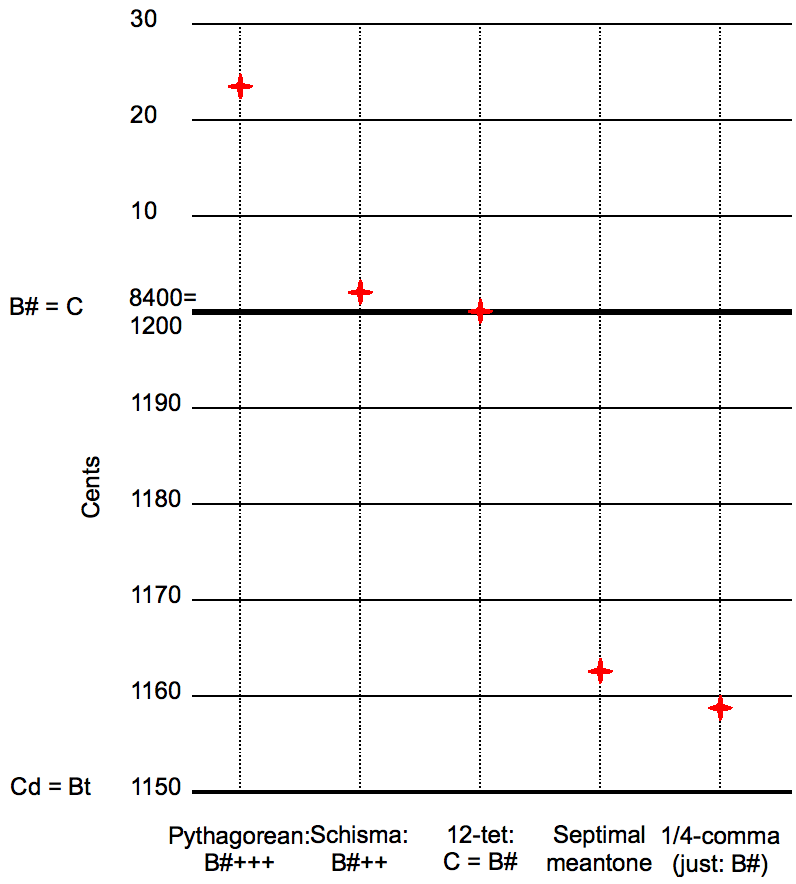
Pietro Aron's early 16th-century solution involved a series of tunings termed meantone temperaments. These systems temper the perfect fifth interval to be slightly flatter than in just intonation, subsequently proceeding similarly to Pythagorean tuning but utilizing tempered fifths instead of just fifths. By flattening the fifth by a quarter-comma, the syntonic comma is effectively eliminated, resulting in just major thirds and minor thirds that are also flattened by a quarter-comma relative to their just intonation ratios, rather than a full comma. Although all fifths within this tuning system now exhibit a slight beating, this effect in quarter-comma meantone is only one-quarter the intensity of the beating observed in the thirds of Pythagorean tuning, given that four fifths approximate one third. This characteristic rendered it an acceptable compromise for Renaissance musicians.
Pythagorean tuning presented a second challenge, unresolved by non-extended meantone temperaments: the issue of modulation (). Modulation is constrained because limiting an octave to 12 pitches results in a discontinuous circle of fifths. A sequence of 12 just fifths, as found in Pythagorean tuning, does not precisely return to the initial pitch, instead deviating by a Pythagorean comma, rendering that specific tonal region of the system largely impractical. This effect is even more pronounced in meantone temperament. The fifth that spans the discontinuity in the circle is designated the wolf interval, due to its pronounced beating, which was historically compared to a "howling" sound. Modern extensions include 53 equal temperament for Pythagorean tuning and 31 equal temperament for quarter-comma meantone.
According to William Hubbard's Musical Dictionary (1908), an anomalous chord is characterized as a "chord containing an interval" that has been "made very sharp or flat in tempering the scale for instruments of fixed pitches."
Well Temperament and Equal Temperament
A significant limitation of most just intonation tunings is their inability to modulate effectively to different keys, a prevalent expressive technique during the common practice period of music. Such modulation necessitates the abandonment of numerous tones from the preceding key, thereby requiring instruments to incorporate additional strings, frets, or holes for each desired key change, which proves highly impractical during instrument construction.
Well temperament refers to a diverse array of tuning systems developed to address this issue, wherein certain keys exhibit greater consonance than others, yet all remain musically viable. This approach generates an extensive spectrum of "key-colors," a characteristic absent in the contemporary standard, 12-tone equal temperament (12-TET). Distinct from meantone temperament, which adjusts the perfect fifth to eliminate the syntonic comma, 12-TET resolves the Pythagorean comma, thereby establishing a cycle of fifths that precisely reiterates after twelve intervals.
This system enabled the intervals of tertian harmony, specifically thirds and fifths, to approximate their just intonation equivalents closely—fifths exhibited nearly imperceptible beating, while thirds were slightly less dissonant than in Pythagorean tuning's syntonic beating. Concurrently, it afforded the flexibility to modulate to any key through diverse methods, including common-tone and enharmonic modulation. Such modulatory freedom also facilitated the extensive incorporation of more remote harmonic relationships, exemplified by the Neapolitan chord, which gained considerable significance among Romantic composers during the 19th century.
Frequently Utilized Equal Temperament Scales
Piano Tuning
- Piano tuning
- Comma
- Regular Temperament
- List of Meantone Intervals
- Whole-Tone Scale
- Pythagorean Interval
- Mathematics of Musical Scales
- Schismatic Temperament
References
Miller, Willis G. The Effects of Non-Equal Temperament on Chopin's Mazurkas. PhD dissertation, University of Houston, October 2001.
- Miller, Willis G. The Effects of Non-Equal Temperament on Chopin's Mazurkas. PhD diss., University of Houston, October 2001.
- Pressler, James. The Temperamental Mr. Purcell. Frog Music Press, UPC 883629638829.
- Steblin, Rita. A History of Key Characteristics in the 18th and Early 19th Centuries. UMI Research Press, Ann Arbor, 1983.
Articles
- Willem Kroesbergen, Andrew Cruickshank: "18th century quotes on J.S. Bach's temperament"
Books
- Tuning And Temperament A Historical Survey (1951) by J. Murray Barbour
- "Temperament" from A supplement to Mr. Chambers's cyclopædia (1753)
- Elements of musical composition: comprehending the rules of thorough bass and the theory of tuning (1812) by William Crotch
- Essay on musical intervals, harmonics, and the temperament of the musical scale, &c (1835) by Wesley Stoker B. Woolhouse
- Modern organ tuning : the how and why? by Hermann Smith (1824–1910)
- The organ viewed from within : a practical handbook on the mechanism of the organ, with a chapter on tuning by John Broadhouse
- Regulation and Repair of Piano and Player Mechanism, Together with Tuning as Science and Art (1909) by William Braid White
- Biddle, Horace Peters (1867). The Musical Scale. Oliver Ditson & Company.
- Biddle, Horace Peters (1867). The Musical Scale. Oliver Ditson & Company.Source: TORIma Academy Archive